How AI Detectors Identify Generated Content: Patterns, Predictability, Tone Issues


In 2026, AI content detection has become essential for content creators, educators, marketers, and businesses. With tools like ChatGPT, Gemini, and Claude producing high-quality text instantly, platforms (Google, academic institutions, publishers) increasingly rely on AI text detectors to flag machine-generated content. But how do AI detectors work exactly? They don’t “read” like humans — they analyze statistical and linguistic signals to spot differences between human and AI writing.
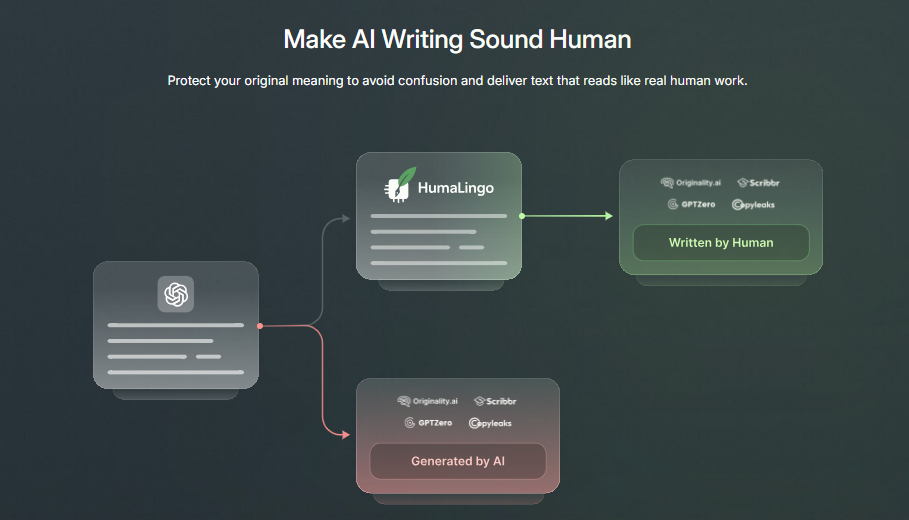
At the heart of most modern AI writing detectors are key metrics: perplexity, burstiness, linguistic patterns, predictability, and subtle tone issues. Understanding these helps explain why some text gets flagged — and why tools like HumaLingo exist to humanize AI output and make it undetectable.
1. Perplexity: Measuring Predictability in AI Text
Perplexity is one of the most widely used signals in AI generated content detection. It quantifies how predictable a sequence of words is to a language model.
- Low perplexity means the text follows highly probable, common patterns — the next word is almost always the “obvious” choice. AI models excel at this because they’re trained to predict the most likely continuation.
- High perplexity indicates surprises: unusual phrasing, creative leaps, typos, or unexpected vocabulary — hallmarks of human writing.
AI text perplexity tends to be lower overall, making content feel smooth but formulaic. Detectors trained on vast datasets compare your text’s perplexity score against known AI vs. human benchmarks. If it’s too low and consistent, the AI detector raises a red flag for AI generated text.
2. Burstiness: The Lack of Natural Variation
Burstiness measures variation in sentence length, complexity, and structure across a document — essentially, how “bursty” or uneven the writing feels.
- Human writers naturally mix short, punchy sentences with longer, detailed ones — creating rhythm and emphasis.
- AI often produces uniform output: medium-length sentences, consistent complexity, and even pacing. This low burstiness is a giveaway.
Burstiness AI detector tools look for this lack of variability. Combined with perplexity, it helps distinguish machine uniformity from human dynamism. Low burstiness + low perplexity is a classic sign of AI writing.
3. Linguistic Patterns and Stylistic Tells
Beyond metrics, detectors scan for repeatable AI writing patterns:
- Repetitive structures: Overuse of transitional phrases (“Moreover,” “In addition”), formulaic introductions/conclusions.
- Uniform sentence structure: Predictable grammar, balanced clauses, rare fragments or run-ons.
- Token patterns: Subtle statistical biases in word/token distribution from training data.
- Stylistic patterns: Overly formal or neutral phrasing, lack of idioms, regional slang, or personal quirks.
These linguistic patterns AI detection relies on come from machine learning classifiers trained on millions of labeled samples (human vs. AI text). Even advanced models leave faint traces — detectors evolve to catch them.
4. Tone Issues: The Missing Human Touch
Tone issues in AI generated text often reveal themselves through uniformity and lack of nuance:
- Consistent tone throughout: AI rarely shifts from formal to casual, sarcastic to earnest, or excited to reflective without prompting.
- Lack of emotional nuance: Flat affect, generic empathy, or missing personal voice.
- Monotonous tone or abrupt shifts only when explicitly instructed — otherwise, even flow without peaks/valleys.
Human writing carries emotional fingerprints: subtle mood changes, humor, frustration, or passion. AI’s default is polished neutrality, which detectors flag as tone uniformity or tone consistency in AI generated text.
Why These Methods Matter — And Their Limitations
While perplexity AI detection, burstiness AI detector, and pattern analysis work well on raw AI output, they’re not foolproof:
- Advanced models (2025–2026 generations) produce higher burstiness and varied predictability.
- Simple edits (rephrasing, adding personal anecdotes) can evade detection.
- False positives affect non-native speakers or highly structured human writing.
This is where humanization tools shine. HumaLingo uses advanced rewriting to boost perplexity, introduce natural burstiness, vary sentence rhythm, inject nuanced tone, and break AI writing patterns — all while keeping your original meaning intact.
Take Control with HumaLingo
If you’re tired of AI detectors flagging your content, HumaLingo turns AI drafts into authentic, human-sounding text that passes scrutiny. Paste your content, humanize it in one click, and publish confidently — whether for blogs, marketing, academics, or emails.
Try the free AI detector first at humalingo to see your text’s AI generated content detection score. Then upgrade to humanize and bypass flags ethically and effectively.
Stay ahead of evolving AI content detection — make your writing truly yours with HumaLingo.