How to Invest in ETFs for the First Time: Step-by-Step Guide for Beginners

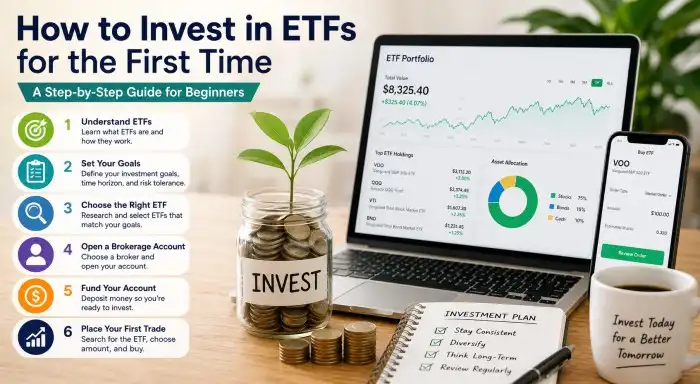
Investing in Exchange-Traded Funds (ETFs) is one of the easiest and most cost-effective ways for beginners to enter the stock market. With built-in diversification, lower fees, and flexibility, ETFs have become a popular choice for new investors. Platforms like The Motley Fool also emphasize ETFs as a smart starting point for building long-term wealth.
Here’s a simple, step-by-step guide to help you get started.
Step 1: Understand What ETFs Are and Why Beginners Love Them
ETFs are investment funds that trade on stock exchanges like individual stocks. Most passively track an index (e.g., S&P 500), providing exposure to hundreds or thousands of companies in one purchase.
Advantages:
- Broad diversification in a single investment.
- Very low expense ratios (often 0.03–0.10%).
- High liquidity and real-time trading.
- Easy to start with small amounts via fractional shares.
Risk Note: While generally less risky than single stocks, ETFs still carry market risk. They suit long-term investors who can handle volatility.
Step 2: Prepare Your Finances First
- Build an emergency fund (3–6 months of expenses).
- Pay down high-interest debt.
- Clarify your goals, time horizon, and risk tolerance (e.g., aggressive growth vs. balanced).
Step 3: Open a Brokerage Account
Choose a beginner-friendly platform with commission-free ETF trades, fractional shares, and strong tools:
- Fidelity, Charles Schwab, or Vanguard (great research and education).
- Robinhood or similar apps for simplicity.
Opening an account is quick and usually free. Link your bank and consider tax-advantaged accounts like Roth IRAs for retirement.
Step 4: Choose the Right ETF for You
This critical step ensures your investment matches your needs. Here’s how to evaluate and select wisely:
Key Factors to Consider:
- Investment Goal & Time Horizon: Long-term growth (20+ years)? Prioritize stock ETFs. Shorter horizon or lower risk? Add bond ETFs.
- Risk Tolerance: Broad market ETFs (e.g., total stock market) are generally suitable for beginners. Sector-specific or leveraged ETFs are riskier and better for experienced investors.
- Expense Ratio: Aim for under 0.20% — lower is better as it directly impacts long-term returns.
- Diversification: Start with broad indexes rather than narrow themes.
- Assets Under Management (AUM): Higher AUM means better liquidity and tighter spreads.
- Tracking Error: How closely the ETF follows its index (look for strong history).
- Tax Efficiency: ETFs are generally tax-efficient due to their structure.
Recommended Starting ETFs for Beginners:
- Vanguard S&P 500 ETF (VOO): Large U.S. companies, ultra-low cost (~0.03%). Excellent core holding.
- Vanguard Total Stock Market ETF (VTI): Broader U.S. exposure.
- Vanguard Total World Stock ETF (VT): Global diversification in one fund.
- Bond ETFs (e.g., Vanguard Total Bond Market – BND): For stability.
Simple Beginner Strategies:
- One-Fund Solution: 100% in a global ETF like VT.
- Two-Fund Portfolio: 80% U.S. stock ETF + 20% international.
- Three-Fund Portfolio: U.S. stocks + International stocks + Bonds.
Use your broker’s ETF screener or tools on sites like ETF.com to compare options. Review the fund’s prospectus and holdings summary.
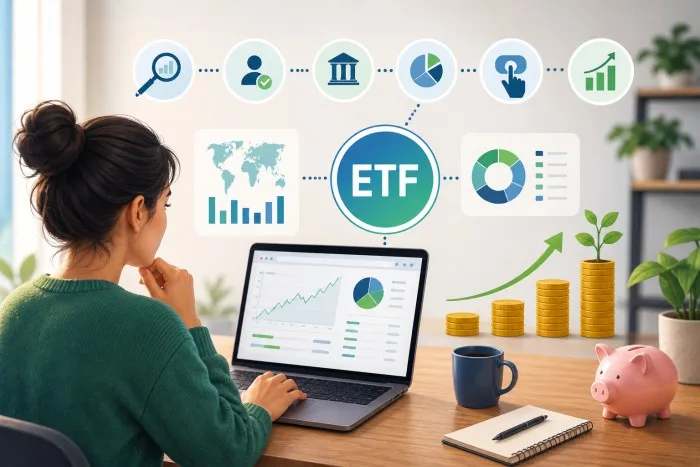
Step 5: Fund Your Account and Make Your First Purchase
Transfer money via ACH. Then:
- Search the ETF ticker.
- Decide shares/dollar amount.
- Choose market or limit order.
- Review fees (usually zero) and confirm.
Set up automatic recurring investments for dollar-cost averaging — buying fixed amounts regularly reduces the impact of market timing.
Step 6: Monitor and Maintain Your Investments
- Review quarterly, not daily.
- Rebalance annually if needed.
- Reinvest dividends.
- Increase contributions as your income grows.
Stay patient — compounding and time in the market are powerful allies.
Common Mistakes to Avoid
- Overcomplicating with too many ETFs.
- Chasing performance or hot sectors.
- Investing short-term money in volatile funds.
- Ignoring your personal risk tolerance.
Final Thoughts
Choosing the right ETF and starting small puts you ahead of most beginners. Focus on low-cost, diversified, broad-market funds and remain consistent. The stock market has rewarded patient, long-term investors historically.
Ready to take action? Open a brokerage account today and invest in your first ETF. The journey to building wealth starts with that first step.
This is for educational purposes only and not personalized advice. Consult a financial advisor for your situation. All investments involve risk, including potential loss of principal.