What Is Managed Private Cloud Hosting? A Beginner’s Guide for Growing Businesses

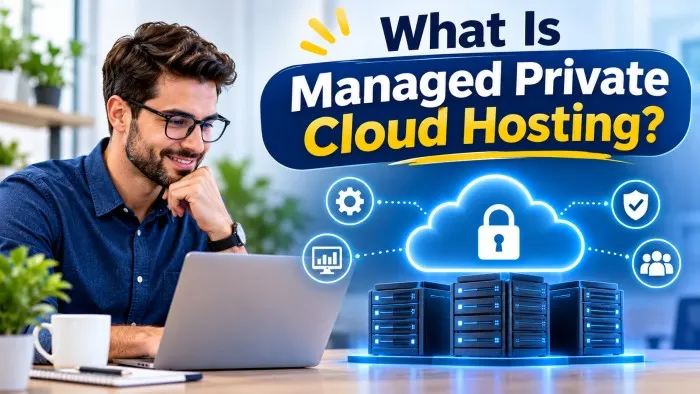
Growing businesses often reach a point where shared hosting feels too limited and a full public cloud setup feels overly complex or costly to manage. That’s where managed private cloud hosting comes in. It offers a dedicated, isolated environment with the convenience of expert management, giving companies the performance, security, and control they need without requiring a large in-house IT team. This guide explains the concept in plain terms so decision-makers can evaluate whether it fits their next stage of growth.
Understanding Private Cloud vs. Public Cloud and Shared Hosting
Shared hosting places many websites on the same server, which keeps costs low but can lead to resource contention and limited customization. Public cloud services (such as those from major hyperscalers) provide on-demand resources across shared infrastructure, delivering excellent scalability yet sometimes introducing multi-tenancy concerns or unpredictable billing.
A private cloud, by contrast, dedicates computing resources—servers, storage, and networking—to a single organization. The infrastructure can sit in a provider’s data center or, less commonly, on-premises. When the provider also handles day-to-day operations, monitoring, updates, security patches, and support, the offering becomes managed private cloud. The result is isolation and control closer to traditional dedicated servers, combined with the flexibility and managed care typically associated with cloud services.
Key Features of Managed Private Cloud Hosting
Several characteristics distinguish a well-run managed private cloud environment:
- Dedicated resources – CPU, memory, storage, and network capacity are reserved for one customer, reducing the “noisy neighbor” problem common in shared environments.
- Isolation and security – Virtual or physical separation limits exposure to other tenants. Providers typically include firewalls, intrusion detection, regular vulnerability scanning, and compliance support (HIPAA, PCI-DSS, GDPR, and similar frameworks where required).
- Scalability with control – Resources can be adjusted as demand grows, yet changes remain under the customer’s governance rather than automatic public-cloud bursting that may surprise the finance team.
- Expert management – The provider monitors uptime, applies patches, manages backups, and handles hardware failures. This frees internal staff to focus on applications and business logic.
- Customization – Organizations can often choose operating systems, specific software stacks, networking configurations, and security policies that match their exact requirements.
- Predictable performance and pricing – Because capacity is reserved, performance remains consistent. Pricing models are usually more transparent than pure consumption-based public cloud billing.
Providers such as Bluehost offer managed private cloud options that package these elements for businesses that want dedicated infrastructure without building and staffing their own private cloud.
Benefits for Growing Businesses
As companies expand, website traffic, application complexity, and data sensitivity typically increase. Managed private cloud hosting addresses several common pain points:
- Improved reliability and speed – Dedicated resources mean faster page loads and more consistent application response times, which directly affect user experience and conversion rates.
- Stronger security posture – Isolation plus professional management reduces the risk of breaches that can damage reputation and trigger regulatory penalties.
- Operational efficiency – Smaller teams no longer need deep expertise in server administration, virtualization, or 24/7 monitoring. The provider’s specialists handle the infrastructure layer.
- Easier compliance – Many industries face strict data-handling rules. A managed private environment makes it simpler to demonstrate control over where data resides and who can access it.
- Room to grow – Unlike fixed dedicated servers, private cloud capacity can usually be expanded without a full hardware refresh or lengthy migration.
- Cost predictability – While more expensive than basic shared hosting, the total cost of ownership often proves lower than hiring additional system administrators or dealing with unexpected public-cloud bills.
These advantages become especially relevant once a business outgrows entry-level hosting yet is not ready—or does not want—to operate a full public-cloud estate with its associated complexity.

When to Consider Making the Switch
Not every company needs managed private cloud hosting from day one. Typical triggers include:
- Consistent high traffic or resource-intensive applications that strain shared plans
- Regulatory or contractual requirements for data isolation
- Growing reliance on custom software or specific technology stacks
- Desire for better uptime guarantees and proactive support
- Plans to expand geographically or launch new digital products that demand reliable infrastructure
If current hosting produces frequent slowdowns, security worries, or support delays, evaluating a managed private cloud becomes a practical next step. A short proof-of-concept or migration assessment with a provider can clarify fit and cost.
Getting Started: Practical Steps
Begin by inventorying current workloads, traffic patterns, compliance needs, and growth forecasts. Share these details with prospective providers so they can size the environment correctly. Ask about service-level agreements (uptime commitments, response times), backup and disaster-recovery options, migration assistance, and the exact scope of “managed” services. Clarify whether the offering uses dedicated physical hardware, virtual private cloud technology, or a hybrid approach.
Once live, establish clear internal processes for requesting changes, reviewing reports, and escalating issues. Treat the provider as an extension of the IT function rather than a black-box vendor. Regular performance and security reviews keep the environment aligned with business goals.
Looking Ahead
Managed private cloud hosting occupies a useful middle ground for growing businesses. It delivers the isolation and performance of dedicated infrastructure while offloading the operational burden that pure self-managed solutions impose. By understanding the core concepts, feature set, and decision criteria outlined above, organizations can determine whether this model supports their next phase of digital growth—and move forward with clearer expectations and fewer surprises.