SSD vs HDD in 2026: Which Storage Option Is Better for Speed and Gaming?

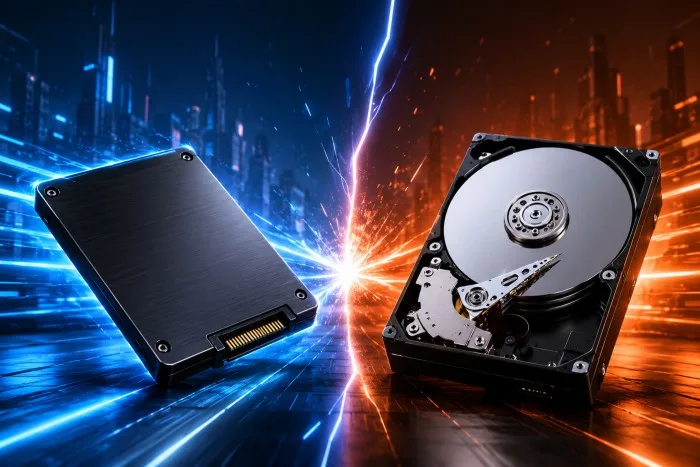
Storage technology has changed dramatically over the past decade, and in 2026, gamers and PC users are increasingly choosing faster, more efficient storage solutions. One of the biggest decisions when building or upgrading a computer is whether to use an SSD (Solid State Drive) or an HDD (Hard Disk Drive).
While both options store data, games, applications, and operating systems, their real-world performance differs significantly. Understanding these differences is important for gamers, creators, students, and professionals who want the best balance between speed, capacity, and cost.
Many PC enthusiasts compare storage options through retailers like Newegg when upgrading gaming systems, laptops, or workstations.
Speed: SSDs Dominate
HDDs rely on spinning platters and mechanical arms, resulting in inherent limitations:
- Sequential read/write speeds: Typically 100–220 MB/s.
- Random access (IOPS): Very low (~75–180 IOPS).
- Latency: 4–10 milliseconds.
SSDs, using NAND flash memory with no moving parts, offer dramatic improvements:
- SATA SSDs: ~500–560 MB/s.
- NVMe PCIe 4.0 SSDs (common in 2026): 5,000–7,500 MB/s.
- PCIe 5.0 SSDs (high-end): Up to 14,000+ MB/s, with PCIe 6.0 emerging.
This translates to real-world differences of 10x–100x in certain operations. SSDs provide near-instantaneous file access, snappier OS boot times, and faster application launches. HDDs feel sluggish by comparison, especially with large files or multitasking.
Gaming Performance: SSDs Are Essential
Gaming in 2026 highlights the gap more than ever. AAA titles with massive open worlds, high-resolution textures, and ray tracing demand quick data access.
Load Times Comparison (Approximate for AAA Games in 2026):
| Game Type | HDD (7200 RPM) | SATA SSD | NVMe SSD (PCIe 4.0/5.0) |
|---|---|---|---|
| Open-World RPG (e.g., Cyberpunk 2077) | 60–90+ seconds | 15–25 seconds | 10–18 seconds |
| FPS/Battle Royale | 25–40 seconds | 8–15 seconds | 5–12 seconds |
| MMO | 45–75 seconds | 10–20 seconds | 8–15 seconds |
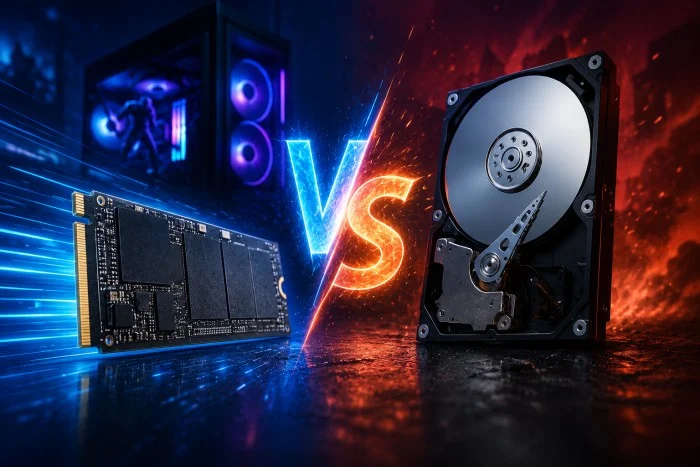
Key Gaming Advantages of SSDs:
- Faster Loading: Reductions of 65–80%+ from HDD to basic SSD.
- Reduced Stuttering & Texture Pop-in: DirectStorage API allows games to pull assets directly from SSD at high speeds, improving 1% lows and overall smoothness (up to 15–30% better frame time consistency in supported titles).
- Fast Travel & Level Transitions: Dramatically quicker.
- Future-Proofing: Many 2026+ games optimize for SSDs, making HDDs feel obsolete for primary storage.
HDDs can still serve for bulk storage of less-played games or media, but installing your active library on an SSD is a major quality-of-life upgrade. During gameplay itself (after loading), FPS differences are minimal, but the overall experience feels far more responsive on SSD.
Other Factors in 2026
- Durability: SSDs are more shock-resistant and reliable (no mechanical failure).
- Power & Heat: SSDs use less power; high-end NVMe drives may need heatsinks.
- Capacity & Cost: HDDs remain cheaper per TB for large archives (e.g., 8–20TB drives). SSD prices have risen in 2026 due to AI-driven NAND demand, but 1–2TB NVMe drives are still the sweet spot for gamers.
Recommendation: Use an NVMe SSD (PCIe 4.0 or 5.0) as your boot drive and for frequently played games. Pair it with a larger HDD if you need massive storage on a budget.
For the latest deals on SSDs, HDDs, and gaming components, check Newegg (affiliate link).
In 2026, SSDs are clearly the better choice for speed and gaming. The performance leap justifies the investment for anyone serious about a smooth, modern experience. If you’re still on an HDD, upgrading to even a mid-range SSD will feel transformative.