How HTTPS and SSL Certificates Can Support Website Security and SEO

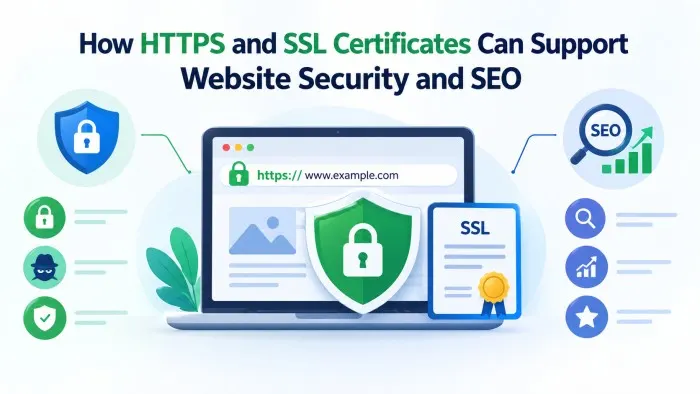
Website security has become an important part of maintaining a reliable online presence. Visitors expect websites to protect information exchanged through forms, login pages, payment systems, and other interactive features. At the same time, search engines consider various technical and user-experience signals when processing websites. HTTPS and SSL certificates can therefore play an important role in both website security and overall SEO efforts.
What Is HTTPS?
HTTPS stands for Hypertext Transfer Protocol Secure. It is the secure version of HTTP and uses encryption to protect information transmitted between a visitor’s browser and a website’s server.
When a website uses HTTPS, browsers typically display a padlock or other security indicator in the address bar. This helps visitors recognize that the connection is encrypted. HTTPS is particularly important for websites that collect personal details, account credentials, contact information, or payment data.
How SSL Certificates Enable HTTPS
An SSL certificate helps establish a secure connection between a website and its visitors. It enables encryption so that information transferred during a session is more difficult for unauthorized parties to intercept or understand.
SSL certificates also help authenticate a website’s identity. Depending on the certificate type, different levels of validation may be involved. Once a certificate is correctly installed and configured, a website can operate through HTTPS instead of sending traffic through an unsecured HTTP connection.
For website owners considering SSL options, Bluehost provides SSL certificate services designed to support encrypted website connections.
HTTPS and Website Security
One of the primary advantages of HTTPS is data protection. Encryption can help safeguard information while it travels between the browser and server. This is particularly relevant for websites handling sensitive information.
HTTPS can also help protect against certain forms of connection tampering. Although an SSL certificate does not make a website completely secure, it provides an important layer of protection for data transmitted over the connection.
Website security also depends on other measures, including strong passwords, secure software, regular updates, access controls, malware protection, and reliable hosting practices.
HTTPS and User Trust
Security indicators can influence how visitors perceive a website. A browser warning about an unsecured connection may make users hesitant to submit information or continue browsing.
HTTPS provides a more secure browsing environment and can contribute to visitor confidence. This can be especially valuable for ecommerce websites, membership platforms, business websites, and services that require users to complete online forms.
Greater trust can also support positive user behavior, such as longer visits and increased engagement, although HTTPS itself should not be viewed as a guarantee of improved conversions.

How HTTPS Relates to SEO
HTTPS is also relevant to search engine optimization. Google has confirmed that HTTPS is a ranking signal, meaning secure websites can receive a ranking benefit as part of Google’s broader ranking systems.
However, HTTPS is only one factor among many. High-quality content, relevant information, technical accessibility, mobile usability, page experience, internal linking, and other SEO elements continue to influence organic search performance.
Switching from HTTP to HTTPS should therefore be treated as an important technical improvement rather than a standalone SEO strategy.
Technical Considerations When Moving to HTTPS
Migrating a website from HTTP to HTTPS requires careful implementation. Website owners should ensure that the SSL certificate is installed correctly and that all important pages load through the secure version.
HTTP URLs should generally be redirected to their corresponding HTTPS URLs using appropriate permanent redirects. Internal links, canonical tags, XML sitemaps, and other references should also be updated where necessary.
Google Search Console should be monitored after migration to identify potential crawling, indexing, or configuration issues. Mixed-content problems should also be addressed because pages may still contain HTTP resources such as images, scripts, or stylesheets.
HTTPS Is Part of a Broader SEO Strategy
A secure website provides a stronger technical foundation, but SEO requires a broader approach. Search-friendly content should answer relevant questions clearly, pages should be easy for search engines to crawl, and the site should provide a useful experience across devices.
Website owners should regularly review technical performance, security, structured data, redirects, broken links, page speed, and indexing status. Keeping these areas in good condition can support a healthier website over time.
Conclusion
HTTPS and SSL certificates serve an important purpose in modern website management. HTTPS encrypts communication between browsers and servers, while SSL certificates help establish the secure connection required for HTTPS.
Beyond security, HTTPS can support user trust and contributes to Google’s ranking systems as a confirmed ranking signal. Nevertheless, it should be considered one component of a larger SEO strategy. Combining secure connections with strong content, sound technical practices, and a positive user experience can create a more dependable foundation for long-term website growth.