Stock Market Indexes Explained: How Beginners Can Understand Market Performance

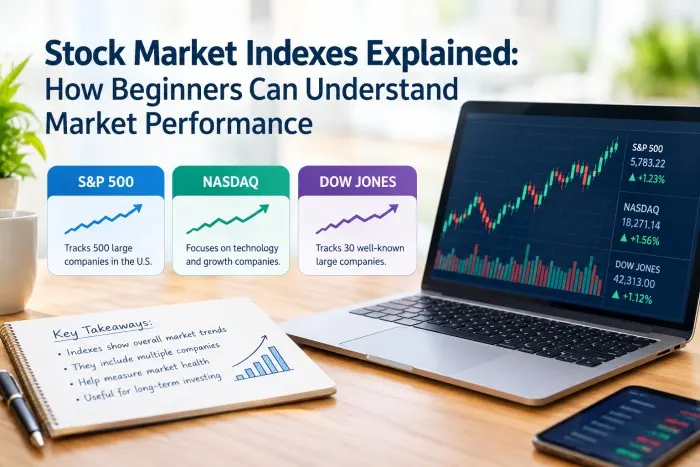
Understanding the stock market can seem complicated for beginners, especially when financial news frequently mentions the S&P 500, Dow Jones, and Nasdaq. These numbers help summarize how selected groups of stocks are performing, making it easier to follow market trends without analyzing every publicly traded company individually.
What Is a Stock Market Index?
A stock market index measures the performance of a selected group of stocks. The companies included in an index are chosen according to specific rules, such as company size, industry, stock exchange listing, or investment characteristics.
An index provides a useful reference point for understanding whether a particular section of the market is rising or falling. For example, an index tracking large American companies can help investors assess the performance of major businesses across several industries.
However, an index does not represent every company in the market. Its movements reflect only the securities included in its calculation.
Major Stock Market Indexes Every Beginner Should Know
Several indexes receive significant attention from investors, analysts, and financial news organizations. Each offers a different perspective on market performance.
S&P 500: This index tracks approximately 500 leading large-cap U.S. companies across various sectors. Because it uses a market-capitalization weighting method, larger companies generally have a greater influence on its performance.
Dow Jones Industrial Average: Commonly called the Dow, this index follows 30 prominent U.S. companies. Unlike the S&P 500, it uses a price-weighted method, meaning stocks with higher share prices generally have more influence on its movements.
Nasdaq Composite: This index covers thousands of companies listed on the Nasdaq Stock Market, including many technology businesses. Its performance can provide insight into technology-related trends, although it also includes companies from other industries.
Russell 2000: This index tracks approximately 2,000 smaller U.S. companies. Investors often follow it to understand how small-cap stocks are performing compared with larger businesses.
These benchmarks differ in their composition and calculation methods, so their daily movements may not always match.
How Do Stock Market Indexes Work?
An index provider establishes rules for selecting companies and calculating their combined performance. Each eligible stock receives a specific weight based on the index methodology.
When the prices of included stocks change, the index value adjusts accordingly. If stocks with substantial weightings rise, the index may increase even when several smaller components decline. Similarly, weakness among influential companies can pull an index lower despite gains elsewhere.
Index values are often expressed in points. However, percentage changes generally provide a more meaningful way to compare performance across indexes with different starting values.
For example, an index increasing from 2,000 to 2,100 has gained 5%. Another index moving from 20,000 to 20,500 has gained 2.5%. Although the second index gained more points, the first recorded the larger percentage increase.
Why Are Stock Market Indexes Important?
Indexes help investors evaluate market direction, compare investment results, and identify broader trends. Instead of examining hundreds of individual stock prices, investors can use an appropriate benchmark to understand how a particular market segment is performing.
They are also useful for comparing portfolio returns. Someone investing primarily in large U.S. companies might compare their results with the S&P 500, while an investor focused on smaller businesses could use the Russell 2000 as a reference.
Resources from The Motley Fool can also help beginners explore market concepts, investment benchmarks, and different approaches to building an investment portfolio.
Nevertheless, index performance should not be treated as a complete measure of economic health. Stock prices can rise even when some households or industries experience financial pressure, and an index may be heavily influenced by a small number of large companies.

What Is the Difference Between an Index and an Index Fund?
A stock market index is a measurement, not an investment that can be purchased directly. An index fund, by contrast, is an investment product designed to track the performance of a particular index.
Index funds are commonly available as mutual funds or exchange-traded funds (ETFs). They offer investors a way to gain exposure to multiple companies through a single investment rather than purchasing each stock separately.
Before investing, it is important to review fund expenses, holdings, diversification, tracking differences, and potential losses. A fund that follows a broad index can still decline significantly when the underlying market falls.
How Beginners Can Read Market Performance More Effectively
New investors can develop a clearer understanding of financial headlines by following a few simple habits:
- Check percentage changes: Focus on the percentage gained or lost instead of comparing point movements alone.
- Understand the index composition: Learn which companies, sectors, or market segments the index represents.
- Compare suitable benchmarks: Evaluate investments against indexes with similar objectives and holdings.
- Look beyond one trading session: Review longer periods to distinguish short-term fluctuations from broader trends.
- Avoid relying on predictions: An index’s past performance does not guarantee future returns.
It is also helpful to understand that different indexes can move in opposite directions on the same day. Such differences may reflect changing investor expectations, sector-specific developments, or the performance of companies with significant index weightings.
Conclusion
Stock market indexes make complex financial information easier to understand by summarizing the performance of selected groups of companies. Learning how the S&P 500, Dow Jones, Nasdaq Composite, and Russell 2000 differ provides a useful foundation for interpreting market news and evaluating investments.
For beginners, the most effective approach is to understand what each index measures, pay attention to percentage changes, and recognize the limitations of market benchmarks. This knowledge can support more informed financial decisions without assuming that any index guarantees profits or predicts future market movements.