How Adobe’s AI Ecosystem Is Reshaping End-to-End Content Production Pipelines


Artificial intelligence is no longer an add-on in creative workflows—it’s becoming the backbone. Across marketing, media, design, and digital storytelling, Adobe’s AI ecosystem is transforming how content moves from an initial idea to final distribution. Instead of fragmented tools and manual handoffs, creators now work within a streamlined pipeline enhanced by machine intelligence and creative insights.
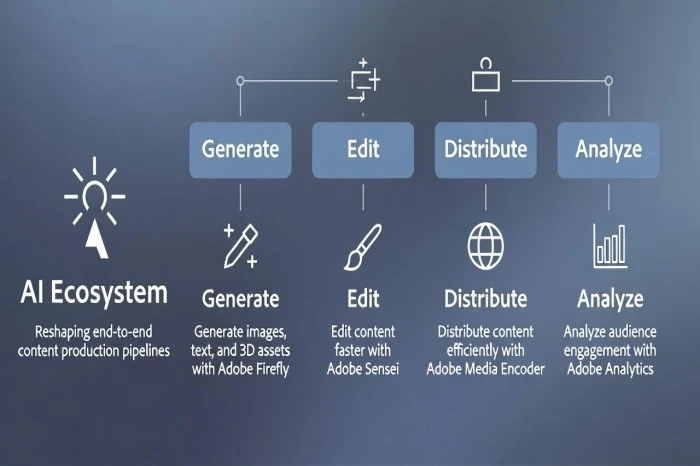
At the core of this transformation is a simple but powerful model: Ideation, Creation, Editing, and Distribution — each stage amplified by intelligent automation that saves time, improves quality, and boosts strategic relevance.
Ideation: Turning Ideas into Action Faster
The content journey starts with ideation, where AI functions as a creative accelerator. Instead of facing the blank page alone, teams can leverage AI-generated prompts to explore concepts, themes, and layouts that match brand messaging and audience intent. Intelligent suggestion engines help refine briefs, suggest audience segments, and reduce the time between concept and execution.
AI-powered ideation ensures that creative work begins with momentum, reducing guesswork and accelerating alignment across cross-functional teams.
Creation: Rapid Production Without Sacrificing Quality
Once a direction is defined, the creation phase benefits from AI’s ability to automate repetitive tasks — from generating multiple visual variations to resizing assets for different platforms. Designers and creators can spend less time on formatting and redundancy, and more time on storytelling and brand impact.
Rather than replacing creative judgment, AI tools enhance human creativity by offering on-demand variations, dynamic layouts, and smart workflows that adapt to evolving campaign needs.
Editing: Smarter Enhancements, Cleaner Final Output
Editing is often the most time-intensive phase in content production. Adobe’s AI-powered tools help streamline this stage with intelligent improvements to imagery, audio, and motion content. Whether enhancing clarity, balancing tones, or optimizing transitions, AI enables more precise results with less manual effort — reducing review cycles and improving output consistency.
The key advantage is contextual awareness: AI understands content type and platform expectations, applying targeted enhancements rather than one-size-fits-all effects.
Distribution: Publishing with Precision
Distribution has evolved into a strategic phase where content must be tailored to audiences and channels. AI assists by automatically optimizing formats, aspect ratios, and metadata for social media, advertising, and web platforms. This ensures the right asset reaches the right audience in the right format.
At scale, this means fewer manual adjustments and more predictability in quality — a crucial factor for enterprise teams managing complex campaigns.
Statistics & Research: The Data Behind the Shift
Quantitative research confirms what creative professionals are experiencing: AI is dramatically reshaping production workflows.
Content Output & Efficiency
- According to a 2025 survey by the Content Marketing Institute, 68% of marketing organizations report that AI tools have increased creative production output by 30% or more — shortening time-to-launch across campaigns.
- A 2024 Deloitte Digital study found that organizations using integrated AI platforms saw a 25% reduction in development time compared with those relying on traditional tools — saving hundreds of labor hours annually.
Quality & Engagement
- In Adobe’s own Digital Trends Report, more than 60% of respondents said AI-assisted creativity helped improve content relevance and audience engagement metrics.
- Data from Forrester shows that personalized content — often produced faster through AI workflows — can increase conversions by 20–30%, especially in digital advertising and email campaigns.
Adoption Trends
- Nearly 76% of enterprise creative teams reported increased adoption of AI-powered editing tools in 2025, according to McKinsey & Company, emphasizing demand for analytics-driven creative insights.
These statistics underline a clear trend: AI is elevating both the efficiency and effectiveness of modern content production pipelines.
A Unified Pipeline, Not Just Isolated Tools
What makes Adobe’s ecosystem powerful is its end-to-end integration. Instead of stitching together separate tools for each stage, teams work within a single ecosystem where data, insights, and assets flow seamlessly from ideation to launch.
This integrated model boosts collaboration and reduces barriers between creative functions. Teams can iterate faster, maintain consistent brand identity, and respond quickly to market shifts — all while lowering operational friction.
The Future of Content Production
As digital demand continues to grow, efficient workflows alone aren’t enough. Creative teams need adaptable systems that support strategic thinking, maintain quality at scale, and enable faster audience impact. Adobe’s AI-powered content pipeline delivers just that — merging automation with human creativity.
By reshaping ideation, creation, editing, and distribution, Adobe is redefining how modern content is produced — helping teams work smarter and tell better stories in a digital-first world.